Clinical longevity intelligence
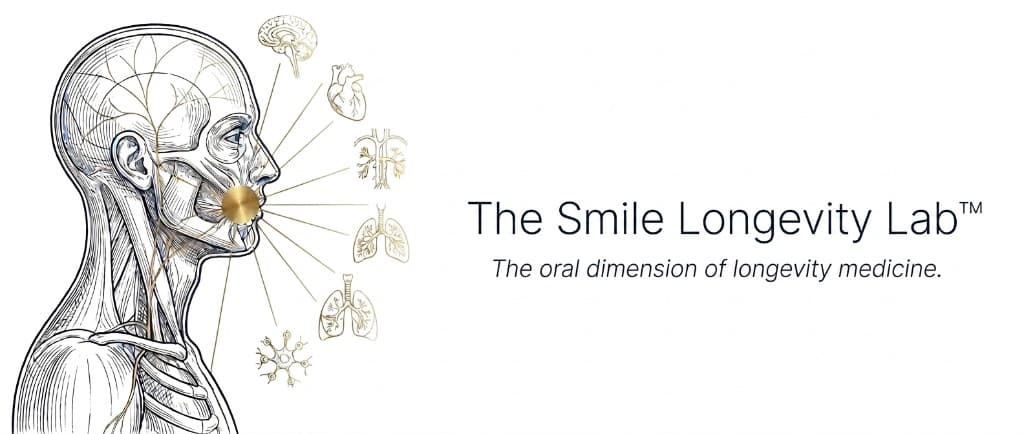
The mouth as a diagnostic window into systemic longevity.
The Smile Longevity Lab translates oral inflammation, microbiome balance, structural integrity, dentition health, and cancer-prevention screening into an Oral Biological Age Score, so clinicians can track change with the same rigor applied to cardiometabolic risk.
Clinical platform
Oral biological age, domain scores, and longitudinal tracking designed for repeatable chairside capture and same-visit interpretation.

Precision diagnostics · longitudinal vigilance
Oral biological age
Oral biological age expresses how oral inflammatory, microbiome, structural, dentition, and mucosal findings align with validated age norms: not a cosmetic score, but a longitudinal clinical index.
Five domains
Inflammation, oral environment or microbiome, structural longevity, dentition longevity, and cancer prevention are weighted into a single OBAS, then interpreted against age-specific norms for your patient’s decade of life.
Track change over time
Repeat visits capture whether hygiene protocols, periodontal therapy, microbiome support, airway interventions, and specialist referrals are moving oral biological age, domain scores, and biomarkers in the right direction.

Perspectives from the field
Why the oral cavity belongs in longevity medicine.
Voices from the published literature on oral–systemic health, periodontal inflammation, and the human microbiome: the foundations our scoring framework is built on.

Michael Glick, DMD
Fields-Rayant Endowed Professor, Penn Dental Medicine · former Editor-in-Chief, JADA
The mouth is a mirror of health and disease in the body.

Yvonne L. Hernandez-Kapila, DDS, PhD
Felix and Mildred Yip Endowed Chair · Professor, UCLA School of Dentistry
Oral health is inextricably linked to systemic health.

David A. Relman, MD
Thomas C. and Joan M. Merigan Professor of Medicine and Microbiology, Stanford University
Humans are composites of microbial and human cells functioning together.

Loreto Abusleme, DDS, PhD
Associate Professor of Oral Microbiology, University of Chile
Periodontal inflammation reflects a dysregulated host–microbiome interaction.

Salvador Nares, DDS, MS, PhD
Professor and Head of Periodontics, University of Illinois Chicago College of Dentistry
Chronic oral inflammation contributes to systemic inflammatory burden.

J. Craig Venter, PhD
Genomics researcher · Founder, J. Craig Venter Institute
The oral cavity is a primary gateway to the body.
Photographs sourced from official faculty pages and Wikimedia Commons. Quotations represent positions documented in each researcher's published work and do not constitute an endorsement of The Smile Longevity Lab.
Frequently asked
The science behind oral biological age.
Plain answers to the questions clinicians and patients most often ask about oral–systemic health, the microbiome, and what it means to measure change over time.
- 01
Why does the mouth matter to overall health?
The mouth is one of the body's primary entry points and houses one of its densest microbial communities. Inflammation, infection, or microbial imbalance there does not stay local; it interfaces directly with the bloodstream, the immune system, and the airway. Modern research treats oral health as part of systemic health rather than a separate specialty.
- 02
What is the oral microbiome, and why should I care about it?
The oral microbiome is the community of bacteria, fungi, and viruses that live on the teeth, gums, tongue, and soft tissues, making it the second most diverse microbial environment in the body after the gut. When balanced it helps protect against pathogens; when disrupted (a state called dysbiosis) it can drive periodontal disease and contribute to systemic inflammation. Its composition shifts measurably with diet, age, medication, and oral hygiene.
- 03
How is inflammation in the mouth linked to biological aging?
Chronic, low-grade inflammation is one of the established hallmarks of biological aging, a process sometimes called inflammaging. Persistent gum inflammation acts as a steady source of inflammatory signaling that research has associated with accelerated tissue aging. This is why periodontal status is increasingly studied alongside other markers of biological age.
- 04
Can oral health really tell us something about systemic disease?
Multiple long-term studies have linked periodontal disease to elevated risk for cardiovascular disease, type 2 diabetes, adverse pregnancy outcomes, and certain cancers. These relationships are largely correlative rather than purely causal, but the consistency across populations makes oral inflammation a credible early signal worth monitoring rather than dismissing.
- 05
What is the relationship between gum disease and cardiovascular disease?
People with moderate to severe periodontitis show higher rates of atherosclerosis and cardiovascular events than peers with healthy gums. Proposed mechanisms include systemic inflammatory spillover and the migration of oral pathogens into vascular plaques, both of which have been documented in peer-reviewed work. Cardiology and dental societies now formally recognize the association.
- 06
Is there a link between oral health and diabetes?
The relationship runs in both directions. Poorly controlled diabetes increases the risk and severity of periodontal disease, and active periodontal inflammation makes glycemic control measurably harder. Clinical trials of periodontal therapy have shown modest but reproducible improvements in HbA1c, supporting the idea that the two systems are coupled.
- 07
Why is the oral cavity considered a useful diagnostic window?
The mouth is one of the few places where bone, soft tissue, microbiome, and immune activity can all be examined non-invasively in a single visit. Saliva carries hormones, antibodies, cytokines, and DNA (many of the same biomarkers measured in blood), while the gingival sulcus continuously samples the local immune response. That combination is unusually rich for both screening and ongoing monitoring.
- 08
Why is a single dental check-up not enough to assess long-term oral health?
A snapshot tells you the current state, but biological systems are best understood by their direction of change. Inflammation, microbial composition, and tissue integrity all fluctuate with stress, illness, diet, and hygiene routines. Without repeat measurements, it is difficult to distinguish a temporary deviation from an emerging trend.
- 09
What does longitudinal tracking actually add?
Tracking the same biomarkers over time turns isolated readings into a trajectory. That makes it possible to detect early drift before clinical disease appears, evaluate whether interventions are actually working, and interpret findings against an individual's own baseline rather than a population average. This is the same logic that already underpins how clinicians monitor blood pressure, HbA1c, and cholesterol.
- 10
What does it mean to think of oral health as a biological age signal?
The idea is that the cumulative state of inflammation, microbiome balance, structural integrity, dentition, and mucosal health can be expressed as an age-equivalent, analogous to epigenetic clocks used elsewhere in longevity research. It is not a cosmetic metric; it is a way to compare an individual's findings against age-norm distributions and follow them over time. The value lies in repeatability and comparison, not in any single number.